The Authentic Recipe Test Misses the Point
The authentic recipe test can flatten a living dish into a rulebook. Learn to trace what matters, adapt thoughtfully and explain the choices you make.
What makes a recipe authentic when the ingredient in the market is different, the kitchen has changed, or the people cooking it have moved? The authentic recipe test often answers with a list of permitted ingredients and methods, as if a dish could be pinned in place. But foodways travel through households and communities; they are carried by memory, available materials and the decisions people make at the stove.
That does not mean every version is interchangeable, or that history and cultural ownership are unimportant. It means a single fixed formula is a poor judge of a dish’s life. A more useful approach is to ask what a recipe is doing, whose practice it represents, and how to describe an adaptation honestly.
What the test overlooks
“Authentic” can point to something meaningful: a preparation associated with a particular place, family or community. It can also be used loosely to claim authority, dismiss a neighbour’s version, or suggest that a dish stopped changing once it became familiar to an outsider. Those uses are not the same.
Recipes are records of practice, not sealed containers. A written formula may preserve one cook’s choices at one moment, while a household’s regular version shifts with season, migration, work schedules, religious observance, prices or the tools at hand. Oral instructions may describe texture and smell rather than fixed quantities, leaving room for a cook to judge what the ingredients need.
Even a familiar dish can hold several legitimate patterns. One family may value a crisp surface; another may prize a softer result. A community might share a defining method while disagreeing about garnishes. The variation is not automatically a flaw to correct. It can be evidence of how people make a dish meaningful in different settings.
Trace the dish’s anchors
When considering an adaptation, begin by identifying the elements that give the dish its character. These might include a particular grain, a sequence of cooking, a balance of sour and rich flavours, a serving custom or a role in a celebration. Do not assume every dish has one hidden essence; ask which features matter to the people who cook and share it.
It helps to distinguish an anchor from a convention. An anchor may be the ingredient or technique around which the dish is understood. A convention may be a common garnish or a preferred vessel that can change without altering the central experience. The distinction depends on the dish and the people connected to it, not on a universal scoring system.
Look for more than one account where you can. A family recipe, a community cookbook, a cook’s explanation and the way a dish is served can each reveal a different part of its meaning. If you are cooking from a tradition that is not yours, credit the source and avoid presenting your variation as the definitive version. Curiosity is more useful than a claim to settle the argument.
Adapt with a clear reason
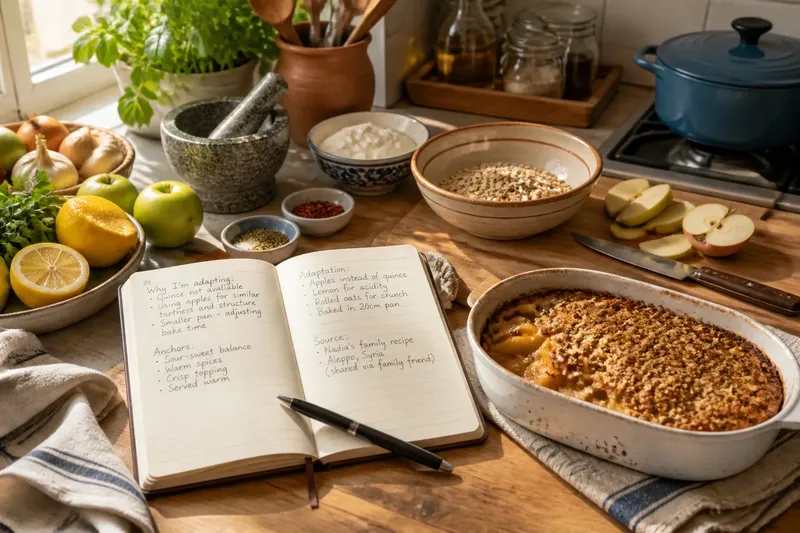
Change is easier to assess when you can name why it is happening. A particular vegetable may be unavailable; a household may need a milder flavour; a small pan may suit the cook’s kitchen better than a wide pot. Each reason points to a different kind of adjustment, and none requires pretending the original recipe was inadequate.
First consider whether you can preserve the dish’s purpose while changing the means. If an ingredient is missing, is there a substitute with a similar role in flavour, texture or structure? If the equipment differs, can the cooking sequence be adjusted while keeping the intended result? A replacement that looks similar may behave differently, so make changes with attention to what the ingredient actually contributes.
Then describe the result plainly. “Inspired by” or “adapted from” can tell a reader that a recipe has been changed without making a grand claim about authenticity. Name a meaningful substitution and explain its practical reason. This gives the next cook useful information and leaves the source tradition visible rather than treating it as an anonymous starting point.
Where should you draw the line?
Can a dish change and remain itself?
Sometimes, yes; sometimes the change creates a related dish rather than the same one. Ask which features the people connected to the dish regard as central, and be candid if your version moves away from them.
Is a family recipe automatically authentic?
It can be an authentic account of that family’s practice, but it cannot speak for every household or community. Name whose version it is instead of turning one memory into a universal rule.
What if an ingredient is unavailable?
Consider the ingredient’s job before choosing a substitute: does it provide acidity, body, fragrance, heat or a particular texture? If a replacement changes the dish substantially, say so and treat the result as an adaptation.
Should I correct someone else’s version?
Not on the strength of a single recipe or a vague claim that there is only one proper form. Ask how the cook learned it and what the dish means in their household; disagreement can be discussed without making a person’s experience disappear.
A week of better questions
You do not need a research project to cook with more care. A simple routine over a week can make the choices behind a recipe clearer, especially if you are adapting a dish for your own kitchen. Keep notes about decisions, not scores.
- When choosing a recipe: Note who wrote it, where it comes from if that is stated, and whether it describes a household or community version. Treat gaps in its background as gaps, not invitations to invent a story.
- Before shopping: Mark the ingredients that seem central and the ones that may be flexible. If you are unsure, compare another account or ask someone familiar with the dish rather than assuming the first version is the only one.
- At the shop: Check what is actually available and decide whether a missing item has a suitable counterpart. If the substitute would change the dish’s defining flavour or texture, consider postponing the recipe or choosing a different dish.
- Before cooking: Write down the reason for any adjustment, such as a limited pan, a household preference or a seasonal ingredient. Keep the explanation specific enough that another cook could understand what changed.
- At the stove: Attend to the recipe’s cues as well as its instructions. A sauce thickening, dough feeling supple or vegetables softening can matter more than mechanically following a quantity that no longer fits the ingredients in your kitchen.
- At the table: Notice how the dish is served and what role it plays. Is it shared from a central plate, paired with something sharp, or made for a particular occasion? Serving can carry meaning that a list of ingredients leaves out.
- After the meal: Record what you would keep and what you would change next time, then describe the version honestly. A short note such as “adapted for the ingredients available” is more useful than a sweeping authenticity claim.
Say you have a recipe for a savoury pie whose original greens are unavailable at the market. You check another account, learn that the greens bring a pleasant bitterness as well as bulk, and choose a locally available leaf with a similar taste rather than a watery vegetable that would alter the filling; in your notes, you explain the substitution. The expected observable result is a filling that keeps a comparable savoury balance, while the recipe remains clearly identified as your adaptation rather than a definitive traditional version.
What is not worth doing
It is not worth treating every difference as a courtroom dispute over who has the real recipe. Nor is it useful to swap ingredients at random and then attach a cultural label to the result. Both approaches flatten the people and decisions that make foodways specific.
A long list of rules can also create false confidence. One printed recipe cannot establish that all cooks from a place use the same ingredient, and a polished photograph cannot tell you how a dish is understood at home. Give more weight to careful attribution, attentive cooking and the limits of what you know.
Let the description travel
Good recipe writing makes room for both inheritance and change. It can name a source, distinguish a common version from a personal one, explain the role of an ingredient and offer a sensible route when that ingredient cannot be found. That kind of detail helps the next cook adapt without mistaking adaptation for correction.
The authentic recipe test misses the point because a dish is not only a formula. It is also a practice passed between people, shaped by kitchens and carried into new circumstances. When you cook, preserve what you have reason to value, change what your situation requires, and make the difference visible; that gives the recipe a more truthful life at your table.