Before the Icebox: How People Kept Food for Later
Before the icebox, food preservation shaped household routines through drying, salting, pickling and cooling—and changed where kitchens stored and prepared food.
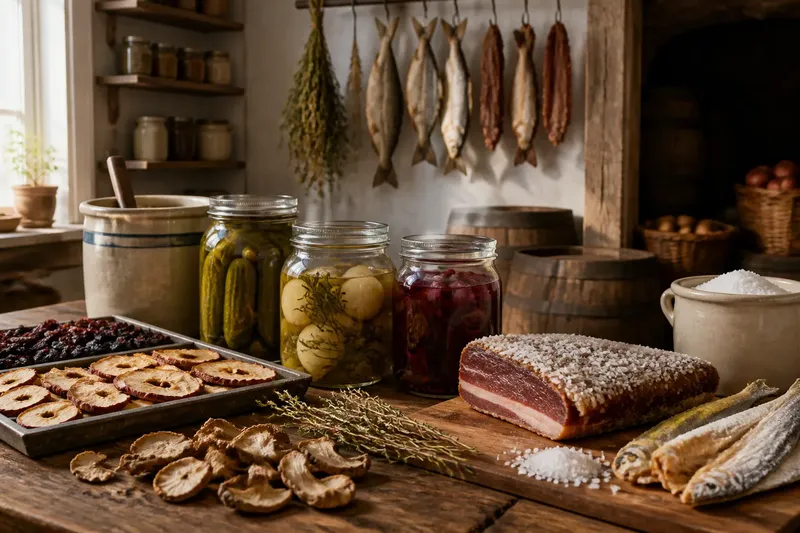
How did households keep food for later before the icebox became ordinary? Food preservation depended on making an ingredient less hospitable to spoilage, then arranging daily work around the materials and conditions at hand. Drying, salting, pickling and cooling were not merely ways to stretch a meal: each gave the kitchen a different rhythm and a different landscape of storage.
Preservation as household work
Fresh food changes after harvest or slaughter. Heat, moisture and exposure to air can hasten deterioration, while suitable preservation alters one or more of those conditions. The result is never simply “fresh food, but older”: a preserved ingredient usually has a changed texture, flavour and best use.
Before domestic refrigeration, households had to coordinate preservation with seasons, available supplies and labour. A glut of fruit might call for drying or pickling; a large quantity of meat might be salted. The practical choice depended on what the household could obtain, how much work it could undertake, and what storage space it had.
Drying and salting
Drying removes moisture by exposing food to moving air, warmth or sun. Fruit, herbs, fish and meat could be laid out, hung or placed on racks, depending on the material and local conditions. Dried food was lighter and more compact than its fresh counterpart, but it could become tough or brittle and often needed soaking or slow cooking.
Drying also moved food preparation into visible spaces. A rack in a breezy loft, a sheltered outdoor area or a warm spot near the hearth could become part of the preservation routine. Weather mattered: damp air could frustrate drying, while dust, insects and animals required attention. The kitchen’s boundaries therefore reached beyond its walls.
Salt preserved food by drawing out moisture and creating conditions in which spoilage was less likely. It could be rubbed onto meat or fish, packed between pieces, or dissolved in a brine. The salted result was intensely savoury and often needed soaking before cooking, so preservation shaped the meal long after the salting itself was done.
Salt also made storage a matter of containers and placement. Barrels, crocks and sturdy tubs held preserved foods; a cool, dependable corner mattered more than a display shelf. Unlike a fresh ingredient used quickly, a salted one occupied space and demanded a plan for drawing from the store without spoiling what remained.
Pickling and sourness
Pickling preserved food in an acidic liquid, commonly vinegar, or through fermentation that produced a sour environment. These approaches are related in the pantry but not identical: vinegar pickles begin with an acidic liquid, while fermented vegetables develop their tang through microbial activity in a suitable brine.
Cucumbers, onions and other vegetables could become sharp, crisp accompaniments that enlivened meals through colder months. Pickling called for jars or crocks and a place to keep them. It also brought a new kind of kitchen attention: clean vessels, intact coverings and close observation of the food’s changing smell and appearance.
Say a household has more cucumbers than it can eat while they are fresh. It could set aside some for a vinegar pickle, keeping them submerged in an acidic liquid in a clean jar; the expected result is a tangy, firmer-tasting accompaniment rather than a fresh cucumber salad. That is a different flavour and texture, not a way to preserve the ingredient unchanged.
Cooling without iceboxes
Cooling slowed change without transforming food in the same way as drying, salting or pickling. A cellar, springhouse or shaded pantry could be cooler than the kitchen, making it useful for ingredients that needed a lower temperature. Such spaces were not equally available to every household, and their usefulness depended on the building, climate and season.
Cooling influenced the house itself. Storage might be placed below ground, near a cold water source or against a shaded wall. The kitchen could stay focused on cooking, while a cellar or larder handled the steady, quiet work of keeping food cool. An icebox later brought that role closer to the cook, but it still relied on ice and regular household attention.
Unlike preserved foods designed for longer keeping, cooled foods remained more like their original selves, but still required watching and timely use. A cool space could support milk, leftovers or produce, yet it was not a modern refrigerator with a controlled temperature. Households learned the limits of their own storage places through ordinary observation.
How did methods change kitchens?
Why preserve food at home?
Preservation helped households make use of seasonal abundance and keep ingredients available when fresh supplies were scarce or inconvenient. It also spread the work across the year: gathering and processing could happen when food was plentiful, while cooking drew on the stored supply later.
Which foods suited each method?
Drying suited foods that could lose moisture without becoming unusable, including herbs, fruit and some fish or meat. Salt and brine were often chosen for animal foods, while vegetables and fruit could be pickled; the best method depended on the ingredient and the household’s supplies.
Did preservation replace cooking?
No. It changed the starting point for cooking rather than removing the need to cook. Dried beans might need soaking and simmering, salted fish might need soaking, and pickles might be served alongside a dish rather than cooked into it.
What is not worth the effort?
It is not worth treating every preservation method as interchangeable or trying to make an ingredient taste exactly as it did when fresh. A preserved food earns its place through a useful keeping quality and a flavour that suits a particular meal.
From store to cooking space
As methods multiplied, kitchens became linked to a network of storage places: racks for drying, vessels for brining, shelves for jars and cooler rooms for perishables. These arrangements affected what cooks could reach quickly and what needed advance preparation. A meal might begin not at the hearth but with a decision about which stored ingredient to soak, rinse or take from the cellar.
The shift towards iceboxes and later household refrigeration changed that relationship by making cooling more immediate and bringing storage nearer to the work surface. It did not erase older habits: dried, salted and pickled foods remained useful for their distinctive flavours, compactness and readiness. The central change was that kitchens gained a new way to hold food close at hand without first changing it so dramatically.
That is the useful distinction when thinking about food preservation history: some methods reshape an ingredient to keep it, while cooling mainly reshapes the conditions around it. Before the icebox, the household had to build those conditions into its rooms, containers and routines—and the pantry was as much a part of the kitchen as the hearth.